Around 38 million Americans have diabetes, and of those, nearly 9 million don’t even know it, according to the Centers for Disease Control and Prevention. For many, it comes down to barriers to diagnosis—limited access to care, high costs, and a lack of specialists near rural or underserved communities. Without access to care, people with diabetes are at a high risk of eye disease, including diabetic retinopathy (DR).
DR is one of the leading causes of vision loss, caused by damage to the small blood vessels in the retina. It often develops without symptoms, so early detection is crucial. But the standard tool for diagnosis—a large, expensive fundus camera—isn’t feasible for every clinic or mobile unit.
At Kennesaw State University, researchers Mahmut Karakaya and Ramazan Aygun are working on a solution that could change how the world diagnoses diabetic eye disease.
Backed by a grant from the National Institutes of Health (NIH), Karakaya and Aygun’s team is developing a smartphone-based imaging system powered by artificial intelligence (AI). Their innovation could make early detection more accessible, affordable, and accurate. Karakaya began exploring the technology a decade ago.
“We were experimenting with smartphones to scan invisible barcodes,” said Karakaya, an assistant professor of computer science in the College of Computing and Software Engineering at Kennesaw State University. “That caused me to think, ‘What if we used smartphones to capture medical images?’”
Later, the research pivoted to retinal imaging, recognizing that existing smartphone tools could capture images but not analyze them. Combining smartphone hardware, a simple lens attachment, and AI to develop a system that can screen for DR in real time, they developed a system to help change the game for primary care.
“With this tool, we can reach people where they are without expensive equipment or needing a specialist on site.”— Ramazan Aygun
To test the system, the team selected Egypt, a country where diabetes affects roughly 20% of the population. Collaborating with local medical professionals, Karakaya and Aygun began screening patients and refining their tool for global use.
Unlike traditional equipment costing upward of $50,000, their system relies on a smartphone, lens adapter, and AI to screen for diabetic retinopathy. It captures a patient’s retinal image, assesses for quality, and AI analyzes it for abnormalities and signs of disease.
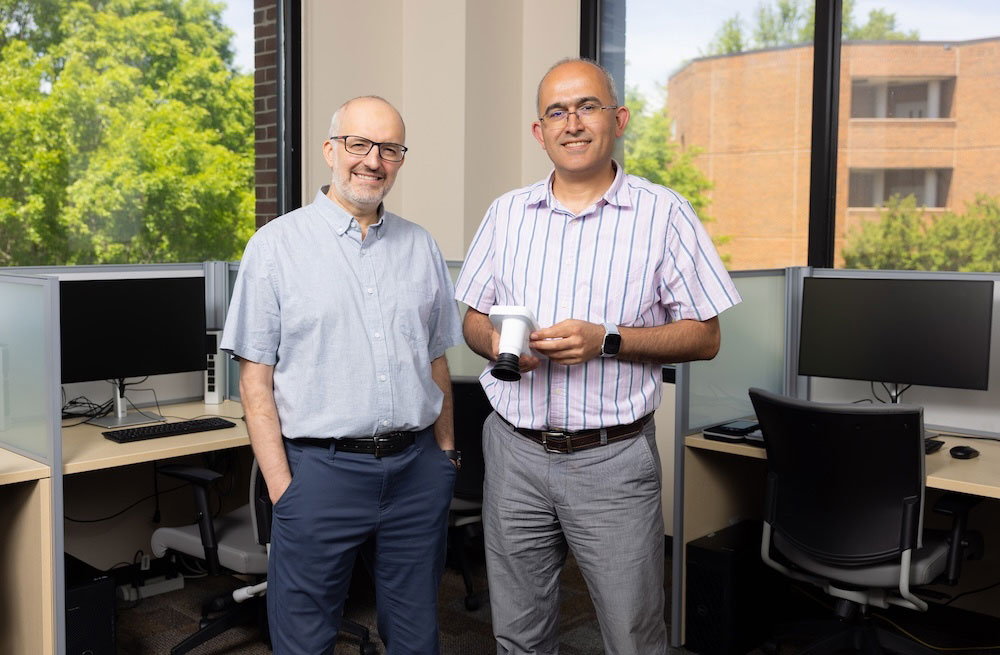
To build user trust, the team developed WisdomNet, an AI framework designed to recognize its own uncertainty. If the model isn’t confident in its assessment, it recommends following up with a specialist.
“The goal isn’t just to build an accurate model, but a trustworthy one,” Aygun added.
To make the AI more robust, they incorporate medical knowledge and plan to use gaze-tracking to teach the algorithm how doctors evaluate retinal images. Their target is 80% diagnostic accuracy by the end of the project.
And KSU students, from undergraduates to Ph.D. candidates, are all playing a key role in helping the system reach that 80% benchmark.
“They are gaining hands-on research experience that will shape their future careers,” Karakaya said. “They’re not just learning how to code or train models. They’re learning how to build ethical, reliable tools that impact lives.”
Long-term, the faculty members hope the system will be used in mobile clinics, pop-up screenings, and even by community health workers for remote monitoring. With proper support and deployment, the technology could address broader healthcare gaps beyond diabetic retinopathy, eventually adapting to detect other vision-threatening diseases like glaucoma and macular degeneration.
“Accessibility is at the core of what we’re doing,” said Karakaya. “This is about removing barriers—cost, distance, technology—and giving people the power to act early.”
Big ideas start here—and keep growing. Be one of the first to know how Kennesaw State’s students and faculty are pushing further, digging deeper, and creating lasting change across Georgia and the world.